

(Photo by Sandra Williams © 2007)
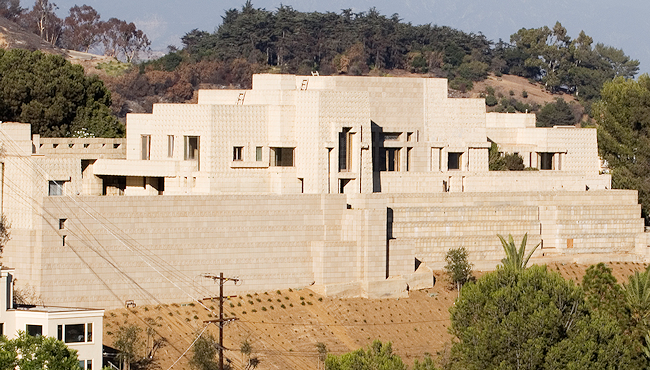
Photo by Sandra Williams © 2007
I recently visited an old lover of mine – and the reunion was bittersweet.
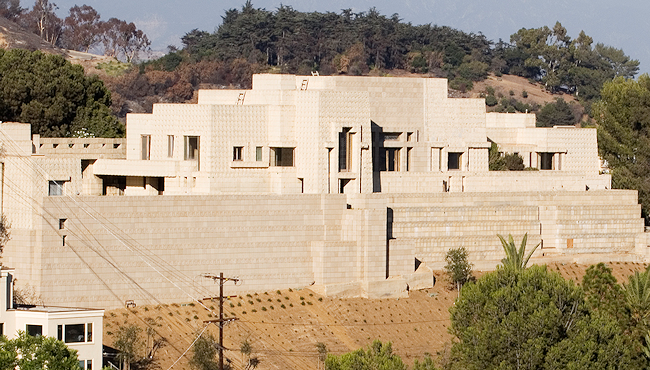
I’m talking about the Ennis House, the Frank Lloyd Wright-designed marvel of a home perched in the hills of Los Feliz, sprawling majestically like a temple to ancient gods. Though there are encouraging signs, I wonder if this frail wonder can be fully restored to its golden days.
When last I saw this object of my deep affection several years ago, this unique Mayan Revival home was falling apart piece by piece. The 1994 earthquake and the 2004-05 torrential rains exacerbated years-in-the-making structural instability and premature decay. It was as if a degenerative disease was slowly overcoming a beautiful movie star. But at the time I had hope for a cure.
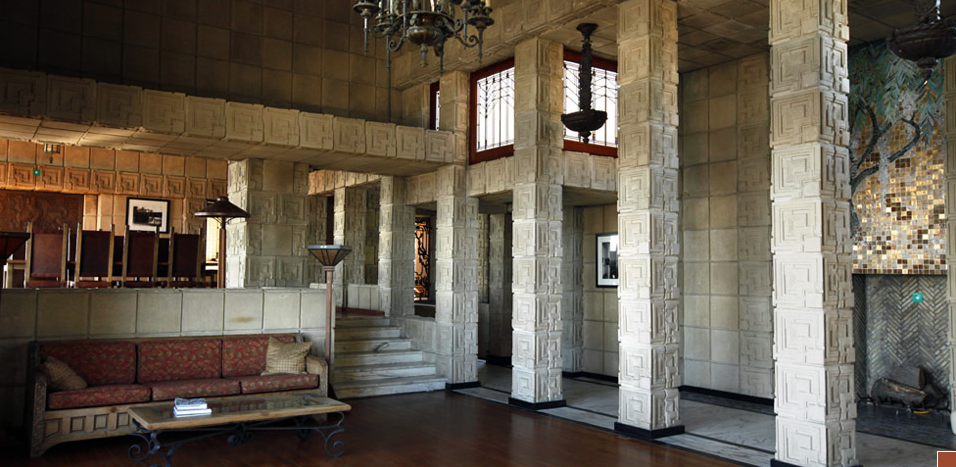
Photo Courtesy of the American Institute of Architecture
Built for Charles and Mabel Ennis in 1924, the structure – a designated city, state, and national landmark – is the fourth and largest of Wright’s textile block designs in the northern Los Angeles area. Its last resident owner, Augustus O. Brown, who donated the home to a public heritage trust, died in 2002 – and the house has been vacant since then.
In 2005, I joined the Ennis House Foundation Board. I was so excited to contribute to the restoration of this architectural gem. I was optimistic that we’d be able to save this treasure, heartened in particular by knowing that the architectural firm of Wiehle-Carr was going to be steering the restoration. I long admired Louis Wiehle, a Wright protégé, and became fast friends with Chris Carr, whose work is impeccable.
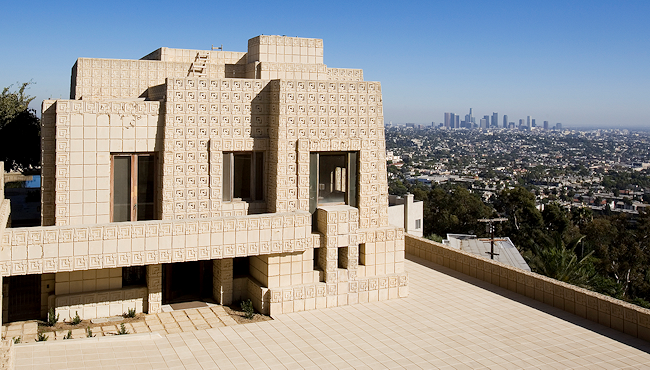
Photo by Sandra Williams © 2007
Alas, not long after joining the board, things began to unravel because of a lack of financial resources, and the preservation project was turned over to a triumvirate consisting of the National Trust for Historic Preservation, Los Angeles Conservancy and Frank Lloyd Wright Building Conservancy.
Though sad about the turn of events, I was still hopeful that funds would be raised and Wiehle-Carr would do its magic. And indeed, in 2006 a Federal Emergency Management Agency (FEMA) grant was issued, as well as a $4.5 million construction loan, which restarted restoration efforts.
Wiehle-Carr, along with Eric Lloyd Wright, oversaw the restoration project that included a new structural support system for the motor court and retaining wall, restoration or replacement of all damaged textile blocks that make up the motor court’s south wall, the dining room tower base structure with its planters and block face, the upper living room block wall face, the restoration of art glass windows, and the new main house roof. Work was completed in 2007 at a cost of nearly $6.4 million.
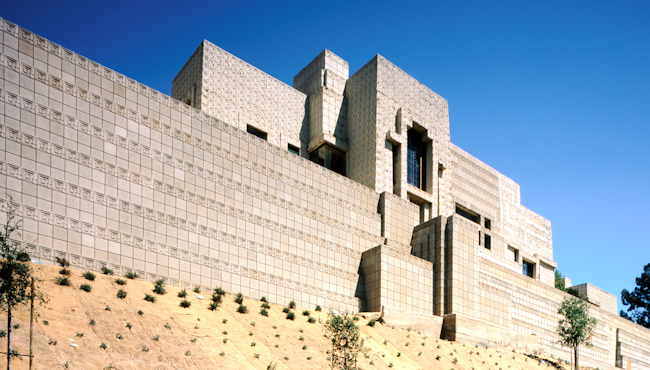
Photo by Sandra Williams © 2007
But more work needed to be done. Which meant more funding was required. But there was none, so The Ennis House Foundation sold the home in 2011 to business executive Ron Burkle for just under $4.5 million. Fortunately, a condition of the sale is an easement that allows public viewing 12 days per year, a condition binding on subsequent buyers.
The good news about Burkle is that he is investing money to continue the restoration. But I can’t help feeling concerned that Burkle is not taking advantage of the talents, resources and knowledge of Wiehle-Carr. The irony is that Louis Wiehle apprenticed with Wright and worked for seven years under the genius architect and another seven years with Taliesen Architects, formed after Wright’s death to complete his unfinished projects.
Those of us who revere the Ennis House understand its place in history as an icon of architectural experimentation and as a unique window into the mind and soul of Wright. I want to feel that Burkle’s team has that same gut emotion, that veneration that others and I have.
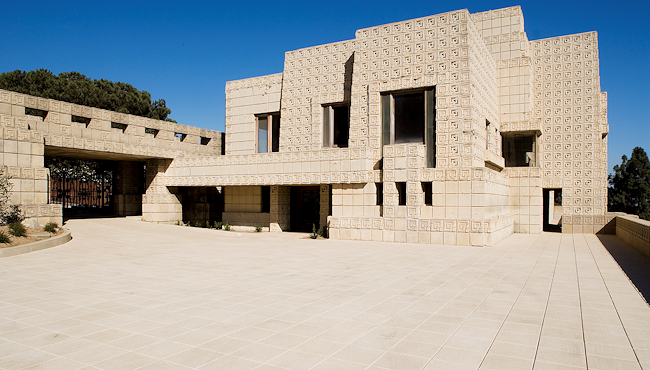
Photo by Sandra Williams © 2007
You might ask why the National Trust-L.A. Conservancy-Wright Building Conservancy triumvirate isn’t nudging Burkle in this direction. For one thing, these organizations have limited power. But it’s also likely that they are simply happy that restoration work is being done at all.
I understand that sentiment. On my recent visit, I was pleased to see that my old lover had not fallen down the hill and that some improvements had been made.
But I’m still concerned that the restoration efforts on the magnificent Ennis House might fall short of a complete cure. I truly hope they will succeed, and that this grand structure will represent all that is good about the forces in the historic preservation movement working together.
Eleanor Schrader is an award winning architectural and interior design historian, professor and consultant who lectures worldwide on the history of architecture, interiors, furniture, and decorative arts. Follow her on Facebook and Twitter.