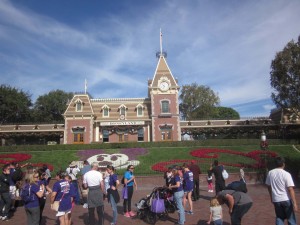
Second Empire railway station. Walt Disney spent some of his childhood in the railroad town of Marceline, Missouri.
We go to Disneyland for the rides, the attractions, and the chance to escape, to lose ourselves in the magic of the Magic Kingdom. But most of us don’t pay too much attention to its architecture, except perhaps in a cursory manner.
I’ve been going to Disneyland since I was a wee one riding on my Dad’s shoulders, but it wasn’t until I recently paid it a visit that I discovered how rich and varied the architecture is. At the Magic Kingdom, Disney Imagineering pulled from many architectural styles from around the world.
So, let’s take a tour, shall we?
When you enter, one of the first things you see is the railway station, done in a Second Empire style. It’s interesting to note that Walt Disney spent some of his childhood in the railroad town of Marceline, Missouri
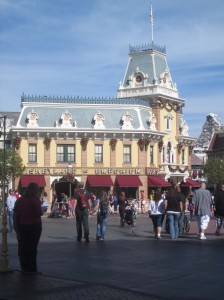
More Second Empire, a popular style in the late 1800s.
Main Street is a hodgepodge of styles. You see more Second Empire, a popular style in the late 1800s. It comes from France, where Emperor Napoleon III and his city planner Georges Hausmann planned much of Paris in this style. The sloping Mansard roofline was based on the sloping roof at Versailles.
Also on Main Street are examples of Queen Anne Victorian, identified by the rounded “turret;” Renaissance Revival, with rooflines reminiscent of the palazzos of the Medicis; and Carpenter Gothic, a popular building style for residences and farmhouses culled from books where carpenters, rather than architects, could build simple houses. The “Gothic” comes from the pointed arches of Gothic cathedrals.
Main Street also has some Greek Revival, with its triangular pediment, and a restaurant that is Carpenter Gothic in the front with a Second Empire roof in the back. The restaurant seems to have been inspired by the Wedding Cake House in Kennebunkport, Maine.
Continuing on, you see Moroccan- and North African-inspired structures in Adventureland, beautiful wrought-iron work in New Orleans Square, and Greek Revival at the Haunted House.
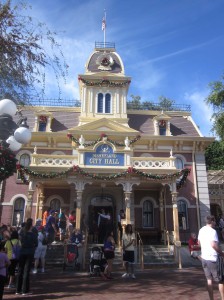
The Second Empire style comes from France, where Emperor Napoleon III and his city planner Georges Haussmann planned much of Paris in this style. The sloping Mansard roofline was based upon the sloping roof at Versailles by Jules-Hardouin Mansart.
Sometimes the level of detail is astonishing. For example, I found a Walter Crane “Iris” wallpaper and a William Morris “Willow” wallpaper in the women’s bathroom of the Blue Bayou Restaurant in New Orleans Square
In Fantasyland no lesser a literary figure than William Shakespeare is invoked. The Tudor-era house with thatched roof is clearly modeled after the cottage of Anne Hathaway, wife of the Bard.
English Tudor, English Jacobean and Medieval fortress styles can also be found in that area.
As to Fantasyland’s iconic Sleeping Beauty Castle – it’s based on Bavaria’s stunning Neuschwanstein Castle.
So, the next time you are in Disneyland, by all means escape into the fantastical world that it is, but take a minute, too, to appreciate the park’s amazing architecture.
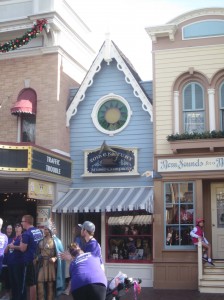 Carpenter Gothic. This was a popular building style for residences and farmhouses, culled from pattern books where carpenters (rather than architects) could build simple houses. The "Gothic" comes from the pointed arches of Gothic Cathedrals. |
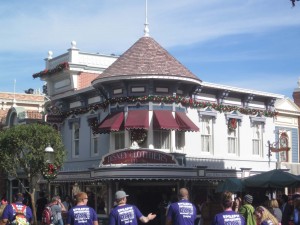 Queen Anne Victorian, identified by the rounded "turret." |
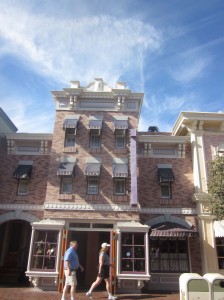 A little bit of Renaissance Revival. The Victorians loved all sorts of revivals, and the rooflines reminiscent of the palazzos of the Medicis, for example, inspired this style |
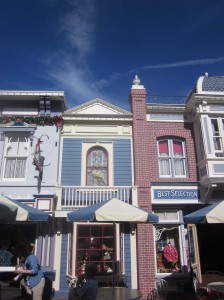 Greek Revival, with its triangular pediment. |
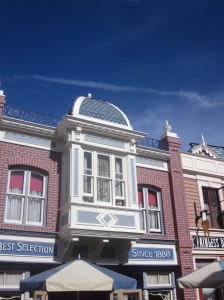 Some great shingles in a Second Empire. Victorians were big on shapely shingles, as new kinds of jigsaws and lathes were invented at this time. |
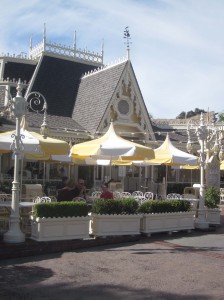 Carpenter Gothic in the front and Second Empire roof in the back! Inspired by the Wedding Cake House in Kennebunkport, Maine. |
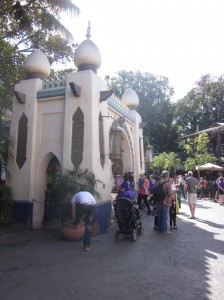 Aladdin's Restaurant in Adventureland is built in a Moroccan-inspired style. |
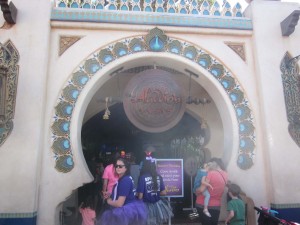 More Moroccan. |
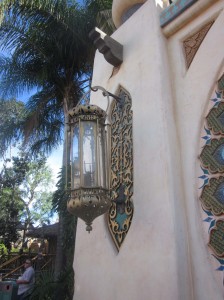 Detail from the exterior of Aladdin’s Restaurant. |
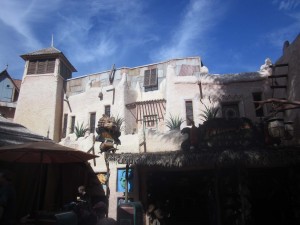 A North African style. |
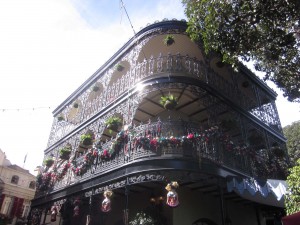 Beautiful wrought-iron work in New Orleans Square. |
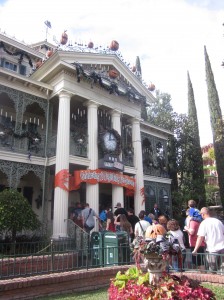 Greek Revival in Haunted House. |
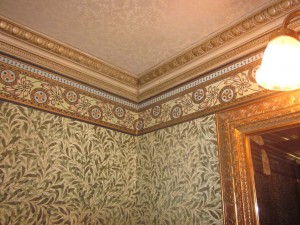 William Morris "Willow" wallpaper in women's bathroom in Blue Bayou Restaurant in New Orleans Square. |
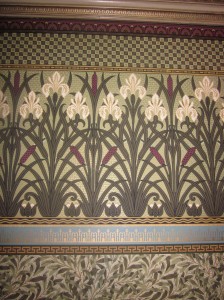 Walter Crane "Iris" wallpaper for Bradbury & Bradbury (wallpaper company) in bathroom entrance in Blue Bayou Restaurant. |
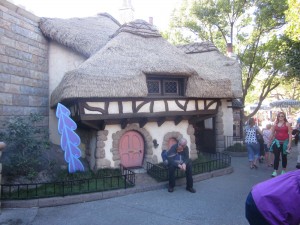 English thatched-roof cottage in Fantasyland based on the home of Anne Hathaway, Shakespeare’s wife, in England. |
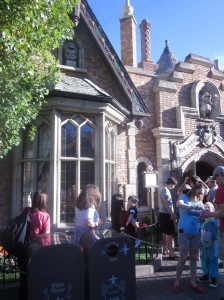 A little English Jacobean architecture (brick) in Mr. Toad's Wild Ride. |
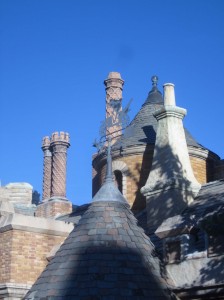 Note the chimney pieces! |
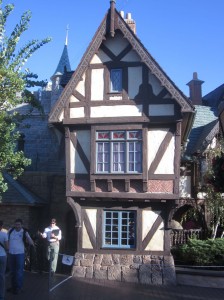 English Tudor in Fantasyland. |
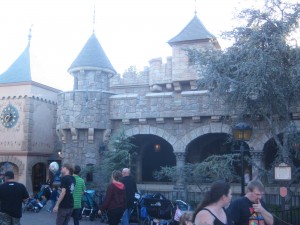 Medieval fortress in Fantasyland. |
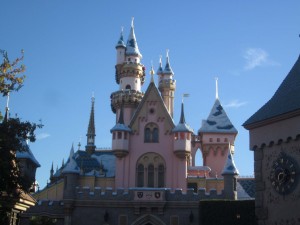 Sleeping Beauty Castle is modeled after Bavaria’s Neuschwanstein Castle. |